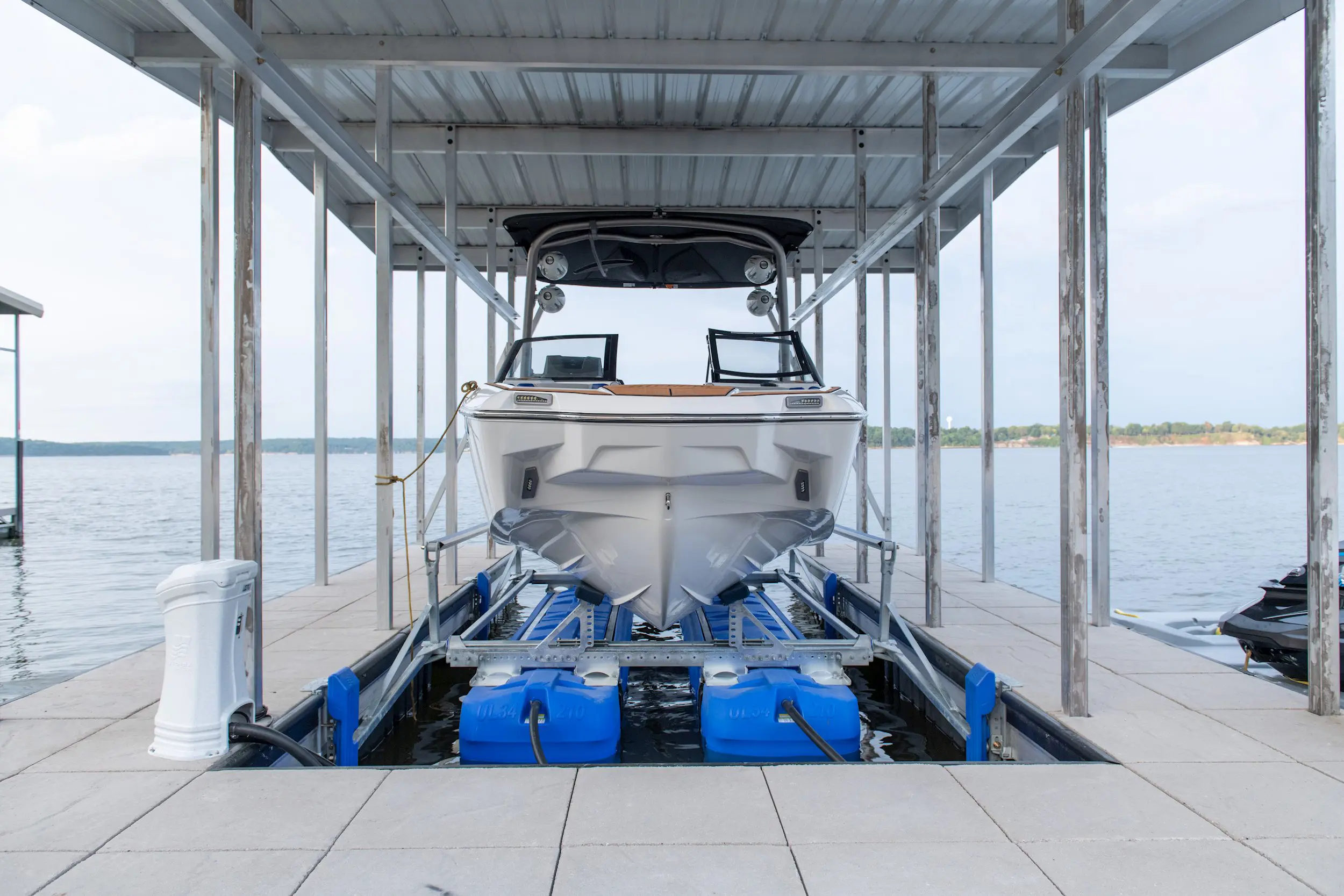
Understanding Boat Lifts for Seasonal vs. Annual Slips
Whether you keep your boat in a slip seasonally (spring–fall) or year-round, a lift protects your hull from blistering, algae growth, and electrolysis. Texas’ mix of freshwater reservoirs and brackish Gulf environments makes a lift even more valuable.
Water levels at major Texas lakes—such as Travis, Conroe, and Lewisville—can swing dramatically throughout the year. Meanwhile, coastal marinas from Kemah to Rockport deal with higher corrosion rates due to salinity and heat. These factors influence whether a new or used lift makes sense.
New vs. Used Boat Lifts: Pros and Cons
| Factor | New Lift | Used Lift |
|---|---|---|
| Cost | Higher upfront; predictable | 20–40% cheaper; varies by condition |
| Warranty | Full manufacturer warranty | Often none; limited seller guarantees |
| Maintenance Needs | Minimal early on | Higher risk of worn cables, pulleys, bunks |
| Fit & Configuration | Custom-fit to slip & boat | May require retrofitting |
| Best For | Long-term annual slip owners | Short-term seasonal slip renters |
When a New Lift Makes More Sense
1. If You Have an Annual Slip
Boat owners keeping their vessel docked year-round place continuous strain on lift motors, cables, and structure. New lifts deliver:
Higher reliability
Better integration with slip dimensions
Warranty coverage (often 5–10 years on structural components)
2. If You Boat in High-Corrosion Areas (Texas Coast)
Saltwater and heat accelerate galvanic corrosion. Newer lifts use:
Hot-dip galvanized or aluminum frames
Sealed motors
Poly or composite bunks resistant to rot
This is important in areas like Galveston Bay, Sabine Lake, or Laguna Madre.
3. If Your Boat Is Over 7,000 lbs
Heavy hulls benefit from new gear since winches, cables, and brackets have known load specs.
When a Used Lift Can Be a Smart Buy
A used lift is worth considering if:
You only rent a slip seasonally
The previous owner maintained detailed service records
You have access to an installer/fabricator who can adapt the lift to your slip
A quality used lift—especially from a reputable marina or dealer—can save thousands without dramatically compromising performance.
Inspect Used Lifts for These Common Issues
Cable wear (rust, frays, flat spots)
Motor integrity (no water intrusion or overheating signs)
Pulley alignment & grinding noises
Bunk condition (soft wood, cracks, or warped brackets)
Hardware corrosion—especially in coastal regions
How to Properly Service a Boat Lift
Boat lifts generally require twice-annual maintenance, once before the season and once at the end.
Annual/Seasonal Checklist
Mechanical Maintenance
Lubricate pulleys, drive gears, and zerk fittings
Inspect cables; replace every 2–5 years depending on use
Test the motor amperage draw to avoid UMC overheating
Check limit switches and leveling
Structural Maintenance
Inspect cradle beams for bending or cracks
Check fasteners for corrosion
Inspect bunks for mildew, rot, or crushing
Electrical & Safety
Ensure GFCI breakers are functional
Check wiring for UV damage
Inspect remote controllers if installed
Texas-Specific Reminders
UV exposure in Texas rapidly degrades vinyl and plastics—cover motors where possible
Lake water levels fluctuate, so adjust lift cables and stops periodically
In brackish / saltwater, add sacrificial zincs to metal components
Texas-Specific Considerations When Buying a Boat Lift
1. Lake Level Variability
Many Texas lakes experience rapid drops during drought cycles (Lake Travis famously lost over 40 feet during 2022–2023). Floating-style lifts or hydraulic lifts are more adaptable in these environments.
2. Heat & UV Exposure
Summers routinely exceed 100°F in much of the state. Look for lifts with:
UV-resistant bunks
Sealed motors
Stainless or hot-dip-galvanized hardware
3. Coastal Corrosion
Saltwater lifts need:
Aluminum frames
Stainless fasteners
Poly or composite bunks
Zinc anodes replaced annually
Helpful Supporting Resources
BoatUS Boat Lift Maintenance Guide: https://www.boatus.com/expert-advice/expert-advice-archive/2019/february/boat-lift-maintenance
Texas Parks & Wildlife Boating Information: https://tpwd.texas.gov/fishboat/boat
Concierge Slip Service: https://seasonalslips.com/concierge